
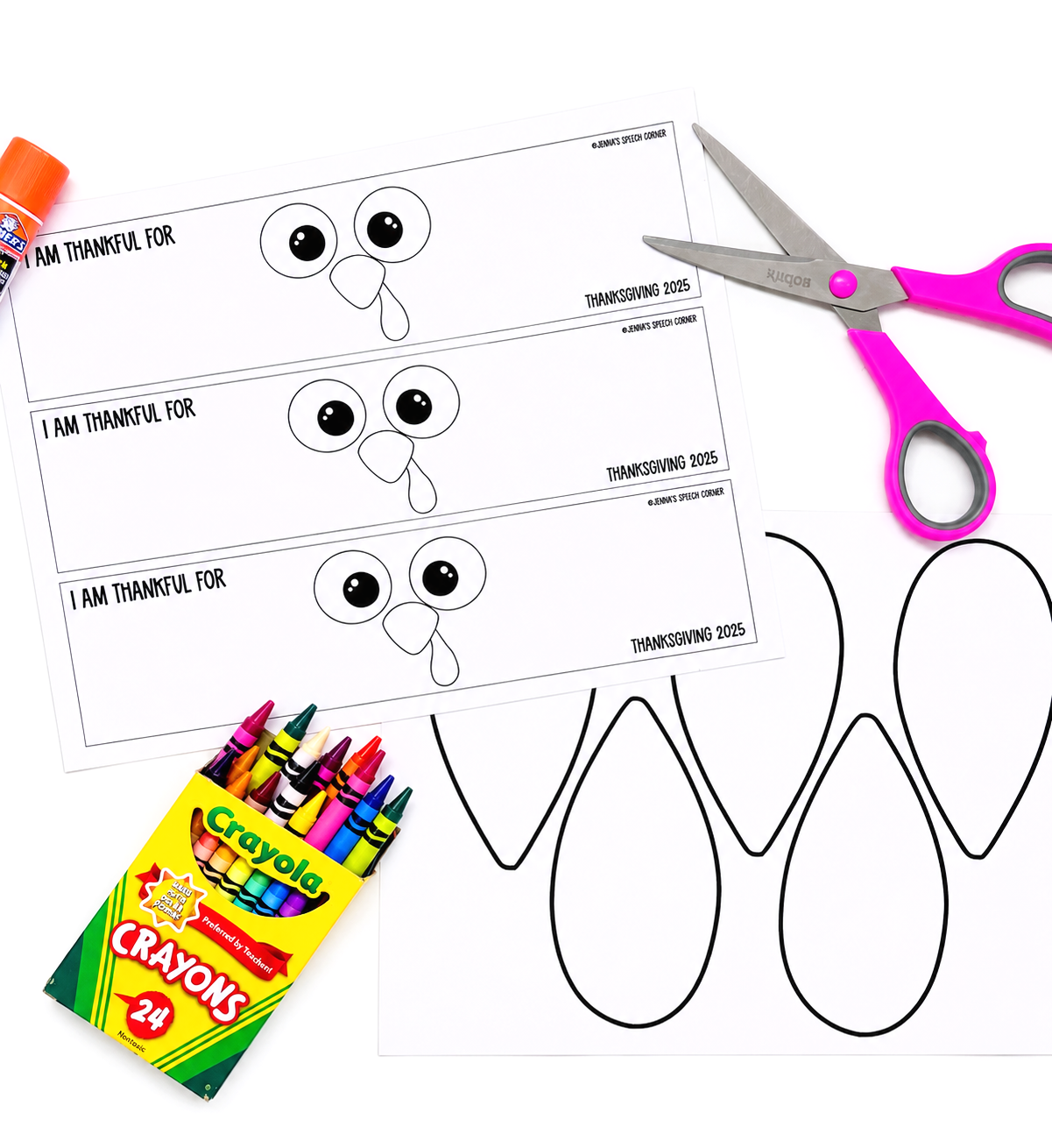
Thanksgiving crafts are cute, but Thanksgiving crafts that sneak in a little speech and language practice? Even better!
With November here, I wanted to share a fun Thanksgiving Turkey Headband Craft that can be used at home, in the classroom, or during speech therapy sessions.
Whether your child is learning to express what they're thankful for or practicing their speech sounds, this activity can be adapted to fit their communication goals.
And the best part? You don't need to be a speech therapist to make everyday activities like this meaningful!
What You'll Need
Stapler (optional, for adult use)
How to Make Your Thanksgiving Turkey Headband
Step 1: Choose Your Turkey!
There are two ways to complete this Thanksgiving craft!
Option 1: I Am Thankful For
Children create a turkey headband by writing, drawing, or sharing things they're thankful for on each feather. This option is perfect for encouraging conversation, expressive language, and vocabulary development.
Option 2: I Can Say My Sounds
Working on articulation? This version lets children practice their speech sound targets while creating their turkey! The printable includes Thanksgiving-themed word lists organized by speech sound to make choosing practice words easier.
Choose the version that best fits your child's needs!
Step 2: Print and Color
Print the headband, feather templates, and any extra strips you may need.
Have your child color their turkey and feathers however they'd like.
Try adding some language practice! Instead of only asking what color they're using, model phrases like "I'm coloring my feather purple!" or "You picked the biggest feather!"
Step 3: Fill in Your Feathers
For the thankfulness version, encourage your child to think of people, places, or things they appreciate.
For the speech sound version, choose words from the included articulation tables that match your child's speech goals. Children can practice their words before writing or drawing them on their feathers.
Parent tip: If your child is practicing speech sounds, follow the targets recommended by their SLP. A few successful practice attempts during the craft are more helpful than turning the entire activity into a drill!
Step 4: Cut and Assemble
Carefully cut out the turkey headband, feathers, and any needed extension strips.
Attach the feathers to the back of the headband using glue, tape, or adult-operated staples.
Wrap the headband around your child's head, adjust the size, and secure the ends together. Allow glue to dry before wearing.
And just like that, you've got an adorable Thanksgiving turkey headband!
How to Incorporate Speech and Language Practice
As an SLP, I love activities that create natural opportunities for communication. Here are a few ways to turn this simple Thanksgiving craft into meaningful speech and language practice.
1. Build Vocabulary
Introduce words like thankful, grateful, feather, decorate, and appreciate.
Use them naturally during the activity rather than making your child memorize definitions.
For example: "We're decorating our feathers to make our turkey colorful!"
2. Expand Sentences
When children share what they're thankful for, help them add more information.
If your child says "Grandma," you might respond, "You're thankful for Grandma because she makes you happy!"
Modeling longer sentences gives children opportunities to hear how ideas can be expanded.
3. Practice Following Directions
Crafting provides lots of opportunities to practice listening and following directions.
Start simple: "Pick up the blue crayon."
When your child is ready, try two-step directions: "Color the feather, then put it on the table."
You can also incorporate location words like behind, next to, and on top.
4. Work on Speech Sounds
The updated turkey headband craft includes Thanksgiving articulation word lists for a variety of speech sounds.
For example, a child working on /p/ might practice pumpkin, pie, or plate.
Children can practice a target word before coloring or attaching a feather. Older children or those working at a more advanced level may practice phrases or sentences instead.
Keep practice at the level recommended by your child's SLP and focus on successful attempts.
5. Practice WH Questions and Sequencing
Encourage conversation by asking questions like:
"Who are you thankful for?"
"What makes you happy?"
"Why is that special to you?"
Once the turkey is finished, have your child explain how they made it using first, next, then, and last.
For children using AAC, pictures, or gestures, offer opportunities to answer questions, make choices, and participate using their preferred communication methods.
Making Everyday Activities Meaningful
One thing I always remind parents is that speech and language practice doesn't have to involve complicated activities or expensive materials.
Sometimes the best communication opportunities happen while doing something as simple as coloring, cutting, and gluing together.
Whether you're working on articulation, expanding sentences, or simply encouraging conversation, this Thanksgiving turkey headband is a fun way to make those little moments count.
I hope you all have so much fun making your turkey headbands together! I'd LOVE to see how they turn out! Feel free to share your photos through my submission form or tag me on social media so I can see your little creations!
Jenna G.
